

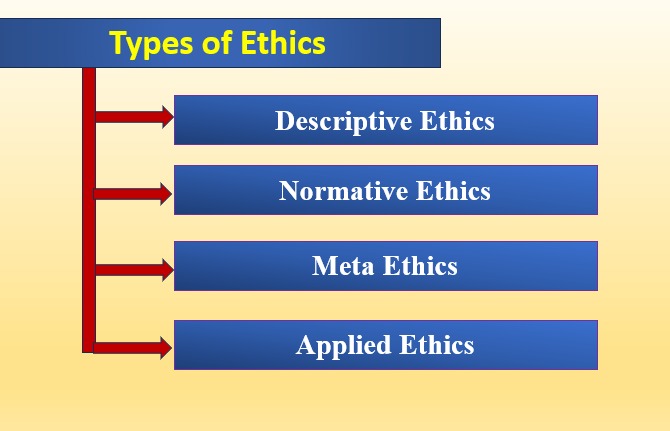
Ethics is the set of rules that advises people how to act or the right way to act. It directs people on what to do and what is right or bad. To maintain the integrity and well-being of human existence, ethics must be present in all domains. The following are the branches of ethics that deal with how people act in different situations.
Descriptive Ethics
Normative Ethics
Meta Ethics
Applied Ethics
Descriptive Ethics
Descriptive ethics belongs to how people behave ethically or morally. It may be based on their cultural norms, societal norms, or individual beliefs. Descriptive ethics is not direct on how one should behave or what is right and wrong. It describes how people behave according to their cultural, societal, and individual beliefs. The following are the examples that describe descriptive ethics.
Example
- A pregnant woman can know the gender of her baby before it is born in the UK, but it is strictly banned or illegal in countries like India.
- Euthanasia is illegal in many countries like India Japan and some states of the USA. If we apply the perspective of human life practically it is legal when humans suffer from high pain and incurable disease. In the case of the Netherlands, it is legal as it provides freedom to patients who are not capable of tolerating their suffering.
- Funerals in Hinduism are different than in Islam. In Hindu, the body is burned with some Hindu procedure whereas in Muslim religion believes in burying.
Normative Ethics
Normative ethics is the part of ethics that focusses at the rules of behaviour that direct us what is right and wrong. It was about figuring out what behaviours are acceptable and what actions are not acceptable, which is the same as figuring out what is right and what is wrong.
Descriptive ethics describe how the people behave orally morally whereas normative ethics prescribes how the people must have to behave morally. It directs the people the way the people must behave in accordance with the ethical behavior.
Various theories describes the normative ethics which belongs to the standard of right and wrong behavior. Next clue
Utilitarianism
This theory was developed by philosophers Jeremy Bentham and John Stuart Mill, emphasising morally correct actions that produce a beneficial influence on society. It concentrates on the reactions responsible for generating overall happiness and well-being in human existence.
Example
Doctors may prescribe the medicine to save the life of the people with limited supply in order to allocate it to maximum people leads to maximizing the overall benefit to the society.
Deontology
The spoken principles of producing what is executed, regardless of the consequences, are part of duente logical ethics. This code of ethics does not specify how to act in light of whether or not it is right. No matter the consequences, directions that fall under this ethical framework are always right or wrong.
Example
Trainer or teacher always tell the truth about the mistakes made by the trainee or student service respectively.
Often, students become disappointed during training upon discovering or identifying errors made by the instructors or trainers. Regardless of the impact on students’ understanding or the training of trainers or teachers, always highlight their errors to facilitate improvement.
Virtue Ethics
This theory describes the way the people develop the virtuous character traits based on moral behaviour. It always focuses on the individual efforts to cultivate virtues like honesty, courage and compassion to implement the self-being of others.
Meta-Ethics
Meta-Ethics is the branch of ethics or philosophy concerned with understanding how the moral or code of conduct is implemented in behavior. The way the people behave is directed by the ethical standards of modernity ethics, and descriptive things describe it, but metaethics focuses on how it is wrong or right.
Example
Moral subjectivism and moral objectivism
Moral subjectivism: it belongs to the moral statements that are not universally true and depend upon the individual’s perspective.
Example: One individual, based on their perspective, asserts that love marriage is preferable to an arranged marriage, while another individual believes it is incorrect..
Moral objectivism: value or belief that direct code of conduct universally. It does not depend upon an individual’s perspectives or feeling. It is accepted universally.
For example: It is a universal truth whether love marriage is better and right than an arrange marriage.
Moral relativist
Some morals or beliefs are changed with community, culture or geographical region. Cultural or individual context is responsible for the changes in beliefs.
Example: marry with more than one girl is illegal in the countries like India whereas it is legal in the countries like Libya, Uganda and Namibia.
Moral realism
Moral realist is the ethics which concerned with universal accepted belief irrespective of individual perspective, culture etc.
Example: All the belief that are related to science are moral realist. Eating more high-calorie food causes obesity, which is the universally accepted belief.
Applied Ethics
An applied ethics agent belongs to the ethics or code of conduct which is implemented practically in various situations. It is the practical application of ethical principles in various areas of human life. Applied ethics are very useful as it needs to be implemented in all the profession. Actually it directs how work is to be completed and how the problems need to be handled while completing the different types of works in the task in the different areas.
Example
Ethics in medical field
Healthcare industry and pharmaceutical industries must follow their ethics in their practices in order to protect the human life. If these areas do not follow their ethics in their practices leads to worst effect on the human life. This ethics is belongs to ethics in science.
Before launching any medicine in the market the pharmaceutical industry must complete the standardized procedure completely.
Hospital must implement the standardized procedures to Diagnose the patients.
Ethics in Business
Any society or country have the regulatory authority that directs the business organizations to execute their business ethically. The code of conduct or the standard of ethics designed by this regulatory authority to run the business organizations without having the customers and society.
Ethics in Education
Here are the ethics plays very important role in building the future. As it belongs to all the areas like medical education, pharmaceutical education, engineering education, law education and the like very areas of Education required to follow the ethical practices in order to build the future of society through educated professionals.