


Elasticity of demand
Elasticity of demand is the degree of responsiveness of demand with respect to the price, income, and many other factors. Factors closely related to customers and factors not related to them can influence the elasticity of demand. The factors that belong to customers include income, preferences or tastes, perception, consumer behaviour, etc., whereas the factors that do not belong to customers but influence their decision-making include government policies, the availability of better substitutes in the market, the effective advertising or promotional strategy of the company, references given by close friends and relatives, etc.
1. Price Elasticity of Demand
The elasticity of demand is influenced by the change in price. The degree of responsiveness of demand to changes in the price is known as price elasticity of demand.
PED = % change in quantity demanded / % change in price
Example
1. If the price of the produce increased by 10% and demand falls by 20%
This example displays price and demand as percentages. If not, you have to convert the first percentage change. Simply convert both values to the same unit.
PED = -20 / 10 = -2
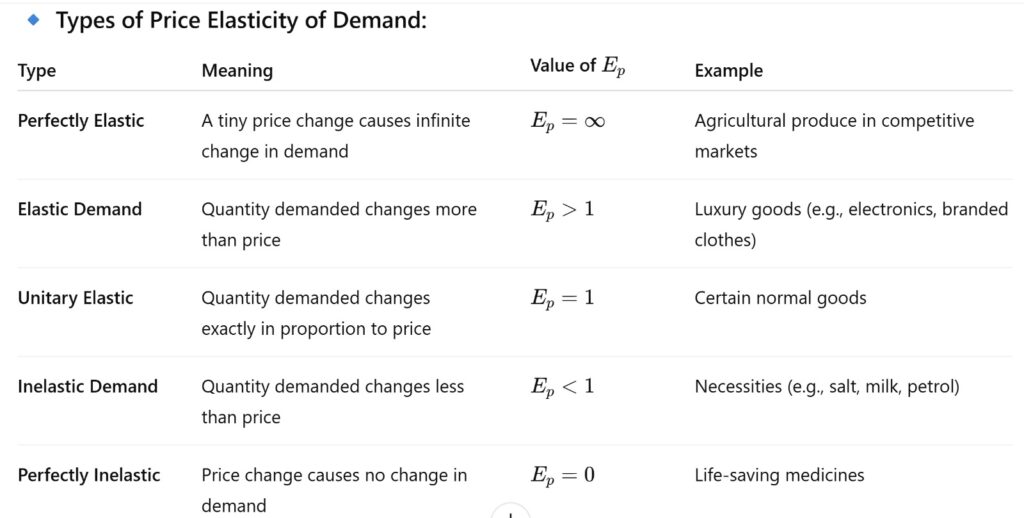
As per Table 1, we can conclude that the price elasticity of demand in the above example is more than one, so demand for this product is elastic.
The following table 1 shows the various types of elasticity of demand based on the degree of elasticity.
Table 1: Types of Price Elasticity of Demand
2. Income Elasticity of demand
Income elasticity of demand is the degree of responsiveness in demand to changes in the income of the consumer/customer.
YED = % change in the demand / % change in income
There are two types of income elasticity of demand
Cross elasticity of demand is concerned with the change in the demand of one product with respect to the change in the price of another product. It can be indicated by the following.
Positive YED: applicable to normal goods on which the law of demand is applicable
Negative YED: applicable to inferior goods for which the law of demand is not applicable
3. Cross Elasticity of Demand
Cross elasticity of demand also has three types.
Positive cross elasticity:
when the price of one good increases, then the demand for another product increases. This effect is known as the positive cross elasticity, which indicates positive influences on the demand for other products.
Example
When the price of tea increases, it influences the increasing demand for coffee. Many customers/consumers prefer coffee when the price of tea increases more than coffee.
Negative cross elasticity:
when the price of one good increases, the demand for the other good decreases. This effect of elasticity of demand is known as negative cross elasticity. It indicates the negative impact of the demand for other goods.
Example
When the price of petrol increases, the demand for cars decreases because the use of cars depends on the petrol prices. Here, demand is influenced negatively, so it is known as negative cross elasticity.
Zero cross elasticity
Actually, this type of cross elasticity is not used in the study, as all the independent products whose prices do not affect the demand of other products come under this category.
Example
When the price of a laptop increases, it does not influence the demand for a car.
Exceptions to the law of demand
The price elasticity of demand indicates the responsiveness of demand to a change in price and income. This inverse relationship of price and income with demand generally applies to most products. The following are the types of products that are exceptions to the law of demand.
Giffen goods:
People with poor purchasing power typically consume Giffen goods. Staple foods for poor consumers can be termed as Giffen goods, which indicates an exception to the law of demand; that is, if the price of such products increases, with other alternative high-priced products. The poor consumer could consume the high-priced alternative product if the price does not increase. But if the alternative products increase, the poor consumer needs to go with the existing product whose price is affordable.
For example, if the price of a banana increased by 10 Rs., whereas the price of an apple increased by 100 Rs. For the poor people, however, the price of bananas increases because the price of alternative fruits is not affordable to the poor consumer, who needs to buy bananas only. Hence, the demand for bananas increases; however, their price increased by 20 per cent.
Veblen Goods:
It consists of luxury goods such as diamonds, iPhones, BMWs, and the like, products whose price is not affordable to the majority of consumers. The demand for such products may be high when prices increase, as the segment that purchases such products feels the status of paying more for luxury products. “Luxury products’ prices are always high” is the mindset of such a segment that prefers to buy costly products.
For example, many consumers/customers prefer to buy iPhones for status, irrespective of the high price.
Speculative Goods
These products are very different from all other products, such as stock market shares, which are bought more when the prices of shares increase consistently. A consistent price increase indicates a positive result for that share, which may be profit, expansion, or any good news. Conversely, when a price drop allows shareholders to sell their shares, it indicates a decrease in demand for those shares that have fallen in price.
Necessities
Medical prescriptions prescribed by doctors are essential and unavoidable products. However, the price increases for prescribed medicines are necessary for the purchase of all patients or customers. But the demand may increase when the price difference is observed by the patient. If the price is higher, the customer thinks that the products may be more effective, whereas if the price is lower, such as the price of generic tablets, which is less than others, it creates the belief that the generic medicine is not as effective as other medicines.