


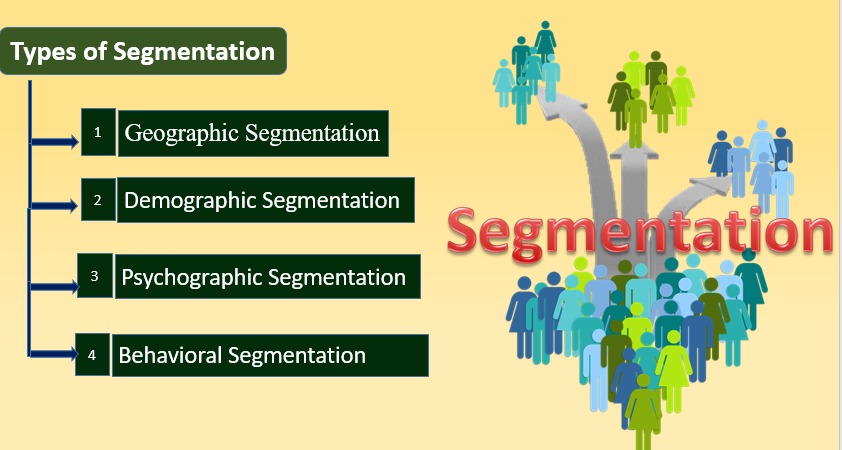
The process of market segmentation involves classifying or subdividing the market or consumers based on shared characteristics. Classifying the group of consumers who share similar characteristics according to the factors listed below. These are the various market segmentation methods that are employed in conjunction with the various factors.
- Demographic segmentation
- Geographic segmentation
- Psychographic segmentation
- Behavioral segmentation
Demographic segmentation
Demographic segmentation entailed the classification, segmentation, or grouping of consumers or markets according to demographic factors. ETC., demographic factors include age, education, gender, occupation, and income.
Example
- Demographic segmentation based on age for the product mobile phone
- Age from 20 to 40
- Age from 40 to 60
- Age 60 and above
The market is divided into three segments or subdivisions based on three distinct age categories, as indicated above. Targeting is a marketing strategy or process that enables an organization to identify a potential segment of consumers who are likely to be interested in purchasing its product.
- Demographic segmentation done based on education as follows
- Education up to HSC
- Education up to Graduation
- Education is more than Graduation
- Uneducated
Based on the education level of the consumers in the aforementioned segments, it will be evident that one factor is distinct from the others. The remaining three segments are comprised of consumers who are highly educated, but their numbers are relatively low. The business organization consistently concentrates on identifying segments that have the potential to become customers. In order to analyse these segments, they must employ a variety of perspectives and dimensions.
The organization implemented a marketing strategy for the educated segments of the market, as they may represent potential customers for the mobile phone product. This strategy was designed to increase the likelihood of them purchasing the product.
Geographic Segmentation
Geographical segmentation is the segmenting of the market based on geographical factors, which are mentioned as follows.
- The region, such as North India, South India, Asia, Europe, Australia, rural-urban etcetera
- Size of the metropolitan area. The market is segmented according to the size of the population in that specific area
- Population density is used to classify the market as urban, suburban, or rural
The market is segmented based on weather patterns that may be prevalent in specific geographical regions: the climate. For instance, the temperature in Switzerland and Himachal Pradesh, India, is low due to the fact that the prospective components that are used to implement the marketing strategy for their consumers are located in these two locations.
Example
- The segmentation of consumers or the division of markets based on the regions of North and South India. South India has a higher demand for white textiles, while North India has a lower demand.
- The following are some of the segments made based on the geographical factors
Based on population size
Rural
Urban
Based on the state or continent
Asia
Europe
America
The classification of consumers or the subdivision of the market based on geographical factors is of paramount importance. In the past, we have observed two segments: rural and urban. The population size is a critical factor in the differentiation of rural and urban areas in these two segments. The corporation applies its marketing strategy from the perspective that the urban area has a greater population than the rural area.
In contrast, the second geographical segmentation will reveal that three segments are established based on the continent: Asia, Europe, and America. The business organization observed that Asian, European, and American consumers exhibited comparable characteristics and individuals. Based on the similar characteristics of these consumers, the company implemented a marketing strategy to target potential segments where they could conduct business activities or attract customers to purchase their products or services.
Psychographic segmentation
Psychographic segmentation is the process of segmenting the market based on the psychological factors that influence the perception of the consumer’s behavior in various ways.
- Psychographic segmentation is done using the following factors
- Thinkers, which include mature and immature customers
- Experiences which include the experience the consumer or the customer is having about the product or services
- Strivers, who include unstable customers and try to copy the rich brand
Example
- For a variety of luxurious products, including the iPhone, psychographic segmentation is necessary to evaluate the consumers’ attitudes toward purchasing the product. Customers who are mature and experienced are more promising than those who are strivers or imitate the wealthy brand.
- immature Customers are difficult to convert towards buying the product, and difficult to make them aware of the product or services.
Behavioral segmentation
Beverly segmentation is the process of segmenting the market according to the diverse behavioural characteristics of the consumers. The behaviour of various consumers is the primary factor that distinguishes them, necessitating a unique analysis by businesses. Customers’ behaviour is a significant factor in shaping consumer purchasing behaviour. Segmentation is the process of dividing the market according to the crammed gearbox, as outlined below:
The factors that are associated with the behaviour of the consumers are the basis for behavioural segmentation. The following factors are employed to define the behavioral segmentation term:
The learned tendency to respond to something that can allure customers to purchase a product or service is represented by the attitude.
Users who engage in heavy or moderate usage, as well as those who lack experience with the product or service, are all potential beneficiaries.
The user status of a product or service is indicative of the experience of using it by a variety of consumers. Every product has its n aonusers, ex-users, potential users, first-time users, and occasionally regular users. Therefore, the segmentation of consumers can be determined by the level of users or uses. be done, and it is very easy to target the potential customer, so the marketing strategy will be applied by the companies.
Example
- Based on behavioral factors such as attitude, the segments made by the business organization will stop
- Positive attitude
- Negative attitude
- Neutral attitude
The three categories of attitudes that customers possess when purchasing or deciding to purchase a particular product or service are as follows. Customers can attract specific products or services by maintaining positive attitudes. In contrast, consumers are able to avoid or criticise the quality of products or services due to negative attitudes.
- Based on the level of usage, the market or the customers can be segmented as follows.
Heavy users of products or services
Light users of products or services
Nonusers of the product or services
The group of consumers who possess the characteristics of the level of use is represented by the aforementioned three segments. Light users indicate that the product or services are consumed moderately, while heavy users indicate that they consume the product or services frequently. Nonusers have no experience with the product or services. Through the targeting process, the business organization concentrates on the segment and implements the marketing strategy for these potential customers.